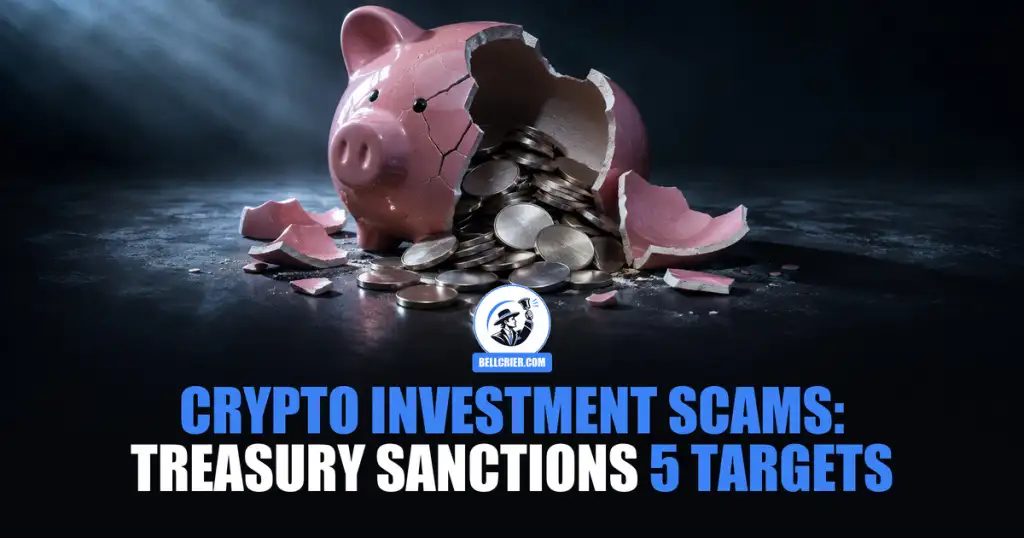
Crypto investment scams targeting Americans are behind new sanctions against three people and two companies, the U.S. Treasury said on November 19, 2026.1 For anyone being urged to invest by an online contact, the Federal Trade Commission warns that promises of guaranteed profits are a scam sign.2
Too long; didn't read?
What Treasury said about crypto investment scams
Treasury said its Office of Foreign Assets Control, known as OFAC, imposed the sanctions on November 19.1 According to the department, one Cambodian scam compound involved in the action primarily targeted Americans and Europeans through virtual currency investment fraud.1
Treasury said the sanctions block the targets' property in the United States or held or controlled by U.S. persons.1 That is the financial restriction at the center of the announcement. Do not treat news of sanctions as a reason to send an online contact another payment.
What a fake crypto investment offer looks like
The FTC describes cryptocurrency as digital currency that generally exists electronically.2 In its general scam guidance, the agency says investment approaches can begin on social media, dating services or through an unexpected message or call.2
The FTC gives the example of an unsolicited investment manager who directs someone to buy cryptocurrency and transfer it to an online account.2 According to the agency, the website may look genuine, but withdrawals can be blocked or tied to high fees.2
These are general warning signs to check against a conversation you are having. They are not a transcript of messages from the operators named in Treasury's announcement.
How to check an investment approach before paying
Use this short checklist before making a transfer:
- Check for promises of certain profits: the FTC warns about offers such as "zero risk."2
- Separate dating from investing: the FTC warns against cryptocurrency investment advice from someone met on a dating service.2
- Search independently: the FTC recommends looking up the company or person's name with words such as scam or complaint.2
If a message instead claims to come from your bank, use the separate guide to checking a suspicious bank text safely. Keep the investment offer and any claimed bank warning separate when explaining what happened.
What to do if you already sent money
- Contact the service used to pay. The FTC advises cryptocurrency scam victims to contact the exchange or ATM operator immediately and request a reversal and refund.4
- Contact your bank if you used a bank transfer. The FTC says to report the scam immediately and ask the bank or credit union to reverse the payment.4
- Gather transaction details. The FBI asks for cryptocurrency addresses, amounts, currency types, transaction identifiers, and dates and times.3
- Write down how contact began. The FBI also asks for communication platforms, websites and phone numbers associated with the scheme.3
Keep your account of events in date order. Distinguish the money you actually sent from any profit figure the website displayed. If you also entered a password through a message, follow the guide on what to do after clicking a phishing link.
Where to report crypto fraud and recovery offers
The FBI directs cryptocurrency scam reports to its Internet Crime Complaint Center at IC3.gov.3 The FTC also directs scam victims to ReportFraud.ftc.gov.4 Use those official addresses when preparing a report.
The FTC warns that people who have already lost money can be approached again by someone claiming to recover it for a fee.5 According to the agency, these callers can pretend to represent government agencies, law firms or consumer groups.5 Before responding to a claimed government contact, the FTC recommends finding the agency's number independently and calling to confirm the approach.5
Frequently asked questions
Can I report crypto investment scams without losing money?
Yes. The FBI encourages reports even when there was no financial loss.3 Include the approach you received and distinguish it from any payment you made.
Can my crypto payment be refunded?
The FTC recommends asking the exchange or ATM operator for a refund, but warns that getting cryptocurrency payments back can be difficult.4 Make the request promptly; do not budget around a promised recovery.
Should I pay someone who promises to recover my money?
The FTC warns against paying an upfront fee to someone who unexpectedly offers to recover scam losses.5 Keep that offer with the other records when reporting what happened.
Sources
- U.S. Treasury: Treasury Targets Cyber Scam Operators and Armed Group Facilitators in Southeast Asia (November 19, 2026)
- FTC: What To Know About Cryptocurrency and Scams
- FBI Internet Crime Complaint Center: Cryptocurrency
- FTC: What To Do if You Were Scammed
- FTC: Refund and Recovery Scams (December 2023)